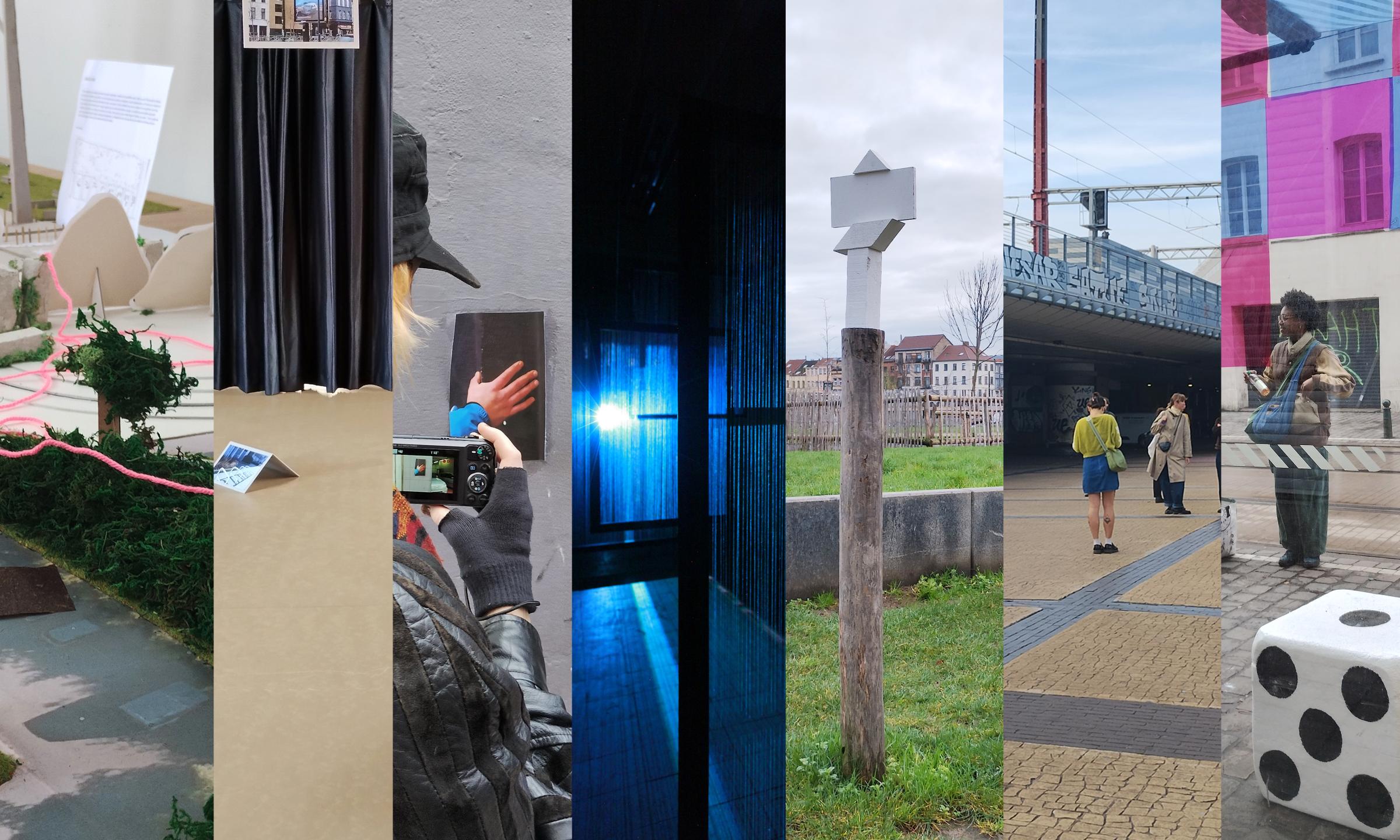
Art in public space - AEP
The Public Space Art Workshop trains artists capable of working in urban, rural, or digital environments.
Definition: Art, Public Space, Multidisciplinarity, and Artistic and Societal Challenges
Artists’ engagement in public space challenges traditional boundaries of art and reaches wide audiences. Artists raise awareness, provoke reflection, and encourage co-creation and dialogue on pressing social, political, or environmental issues.
Public space is approached as a conditional notion: freedom of access for oneself, freedom of access for others, and the possibility of encounters free from surveillance.
The workshop provides training in art and public space, offering each student a stimulating framework to explore the relational potential of both fields.
Pedagogical activities are structured around back-and-forth experiences between two zones: the studio and the field.
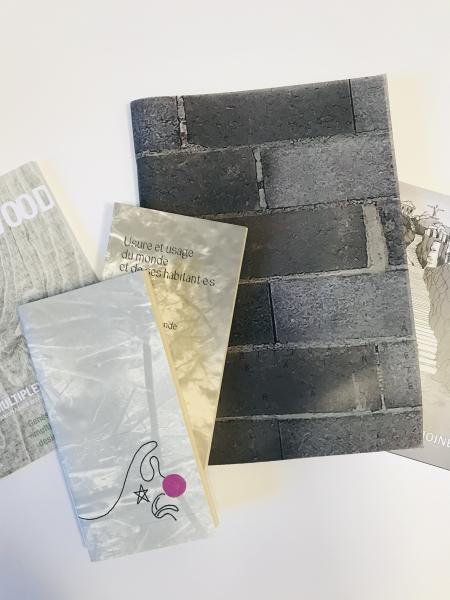
Fundamental skills are taught in drawing, volume and space, image, video and sound, digital media, and publishing. Artistic actions, along with the conditions of production and exhibition, are approached with a strong awareness of ecological impact.
Throughout the program, students develop their own studio practice, shaped by multidisciplinarity, a culture of exchange, curiosity, and a thirst for knowledge.
The workshop is in constant contact with the city. Students confront the reality of concrete or virtual territories shaped by contemporary issues.
Specific working contexts (based on urban, social, or artistic notions) are proposed through phases of reflection and production.
Action methods are open to tangible evidence (document research, material sampling, image capture, interaction, etc.).
Approaches oriented toward the production of forms, images, and narratives are focused on a specific territory and its users, culminating in critical analyses of identified situations.
In general, field investigations support the early stages of in/ex situ projects.
Theoretical work, drawing from urban studies, contextual art, and media theory, helps students understand situations and take action.
The teaching team fosters a reflective approach rooted in a culture of sharing artistic gestures, forms, and modes of exhibition—encouraging the desire to explore and generate knowledge while asking questions.
The workshop supports and questions the effort to find the right distance from the complex realities of the spaces we inhabit.
Students gain autonomy, define their position, fuel their creative drive, and assert themselves within a collective.
Bachelor’s Degree – 180 Credits (1st Cycle)
In the studio, teaching is organized around individual or group projects developed over the course of the year. It is structured around specific territories and/or themes, which are regularly renewed and supported by texts, publications, current information, and contemporary research.
To this end, each student submits proposals in response to the specific issues raised, taking into account the instructors’ recommendations and the requirements of the assigned work. This includes submitting pre-projects, projects, and final works, all in relation to the courses taught and presented.
Theoretical courses focus on the application of theories drawn from various artistic practices and explore the role of art and the artist through historical thinking and contemporary creation.
Technical courses offer complementary tools to help students acquire specific and diversified know-how.
Master’s Degree – 120 Credits (2nd Cycle)
All courses aim primarily to develop the student’s autonomy in producing and advancing their artistic work. This includes the ability to articulate concepts, assume their implications, and subject their artistic practice to critical analysis. Students are encouraged to develop their creative work in line with current artistic demands, fostering perception, expression, and the development of a perspective open to the world.
We train students to grasp the artistic dimension by encouraging the development of creative processes.
We offer them a culturally specific education aligned with their chosen path, grounded in a pedagogical and methodological approach that broadens their understanding of the world of creation. We expose them to the diversity of artistic and theoretical practices through the discovery of contemporary artistic thinking and processes across a range of genres and contexts.
PRE-REGISTRATION:
All admission applications must be submitted via the admissions portal. The website allows you to apply and upload all the necessary documents for your pre-registration.
Entry into the First Year of the First Cycle (B1)
Admission into the first year of the Bachelor's program is subject to passing an entrance examination.
The exam consists of three parts: a practical test, a research-based test, and a motivation interview during which the candidate may present a portfolio of works.
The exam is open to all applicants; no prior artistic training is required.
Entry During the Bachelor’s Program (B2 and B3)
Admission into the second or third year of the Bachelor's program at ArBA-EsA is based on an artistic portfolio.
For selected candidates, an interview and/or practical test is organized and coordinated directly by the program coordinator.
Entry into the Second Cycle (Master's Program)
Admission into the Master's program is based on an artistic portfolio.
For selected candidates, an interview is organized and coordinated by the program coordinator.
Professeur titulaire : Cédric Noël
Professeur : Jean-François Fontaine
Assistant·e : Anaïs Chabeur
Contact : aesp@arba-esa.be


Images : Anaïs Chabeur, Laure Cottin Stefanelli, Jean-François Fontaine, Eléa Germain, Mila Gesta, Maud Gourdon, Thomas Lambert, Nicolas Lefebvre, Laura Morier-Genoud, Cédric Noël, Georgia Papoutsi, Jennifer Prin